

Research theme
(1) Mechanisms of mechanoresponses
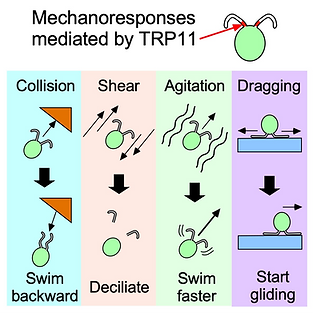
Organisms sense forces generated by contact, growth, vibration, and they evoke sensations such as hearing and touch and regulate physiological phenomena. The sense of detecting force is called mechanoreception. Here, the prefix 'mechano-' means 'related to mechanics.' Even single-celled organisms, whose cells are exposed directly to the environment, exhibit various responses to mechanical stimuli and have been studied as model organisms for mechanoreception. The single-celled alga Chlamydomonas, which we use in our experiments, shows behaviors such as reversal of swimming direction when it collides with obstacles or shedding of cilia in response to shear. We have identified ion channels involved in the mechanical responses of Chlamydomonas and elucidated the cellular-level mechanisms of these mechanical responses.
(2) Mechanosensitive channel
The sensor molecules that allow cells to sense mechanical stimuli are mechanoreceptor channels. These channels detect tension in the cell membrane, and open ion-permeable pores to excite to cell electrically. In humans, various senses such as touch and hearing are produced by mechanoreceptor channels. In our laboratory, we have been studying the operating mechanism of mechanoreceptor channels at the molecular level. Collaborating with many researchers, we have measured single-molecule currents of mechanoreceptor channels in E. coli, yeast, plants, and protists at the pA level (0.000000000001 amperes) using a technique called patch-clamp. By genetically modifying channel molecules, we are on the way to univeil the molecular mechanisms.


(3) Ciliary motility
Cilia and flagella are important motile structures in living organisms. The movement of sperm is essential for fertilization, and the ciliated epithelium of the trachea more the dust attached on the mucosa. The cilia of Chlamydomonas are used widely as a model organism for the study of cilia and flagella. Cilia do not beat monotonously; they skillfully adjust the power and direction of their beating to control water flow. In single-celled organisms, they can even reverse the swimming direction on contacting an obstacle. Research focuses on the mechanisms of ciliary movement control, for instanse, by calcium ions. Some cilia move, while others, called primary cilia, do not move at all. Each cell has only one primary cilium, which functions as a sensor (antenna). We have revealed that motile cilia also have sensory functions and respond to mechanical, thermal, and chemical stimuli.

